
Jira Cloud Plugin Documentation (depr)
1. Getting Started: Using the Adapter
1.1 Operations Overview
This section is intended to guide end users on how to operate the Jira Cloud Digital Thread Plugin once it has been properly installed and configured. If you haven’t completed these steps yet, please refer to those sections before proceeding.
The Jira Cloud DT Plugin is used to:
Create links between Jira issues and items/objects present in external systems, which may include systems other than Jira.
These links are then published to the SBE platform using the Jira Adapter, enabling centralized traceability and visibility across tools.
1.2 Accessing the Adapter
The primary function of the plugin is to add a panel to Jira Issues that displays related models from the SBE instance and enables linking to these models.
It also enables linking to the Models in SBE.
After the installation, the plugin can be accessed from the Issue view page.
1.3 Attaching & Connecting
Adding the Digital Thread panel on an Issue to show related Models on the Digital Thread.
Enabling Linking to the Models in SBE.
Channel properties
Property | Mandatory | Description |
|---|---|---|
| Yes | The key of the project (e.g., for project name |
| No | Only issues associated with the given release will be published. |
| No | Only issues associated with the given component will be published. (Value is case-sensitive) |
The following valid combinations can be used:
|
|
|
|---|---|---|
✅ | ❌ | ❌ |
✅ | ✅ | ❌ |
✅ | ❌ | ✅ |
✅ | ✅ | ✅ |
Note: projectArea must always be provided. release and component can be optionally included in any combination.
1.4 Publishing Items
All items within the Channel scope, including their plugin links, are published.
Links to items outside the Channel scope are not published.
The ASOT links stored inside Jira are published as
Reflectedlinks
1.5 Refreshing Items
Refreshing the channel with links: Digital Thread links, other relations and properties remain intact and unchanged.
1.6 Verify
NA
1.7 Advanced Operations
Add: Create new links from the SBE interface.
Refresh: Update the link view by refreshing the panel in the web interface.
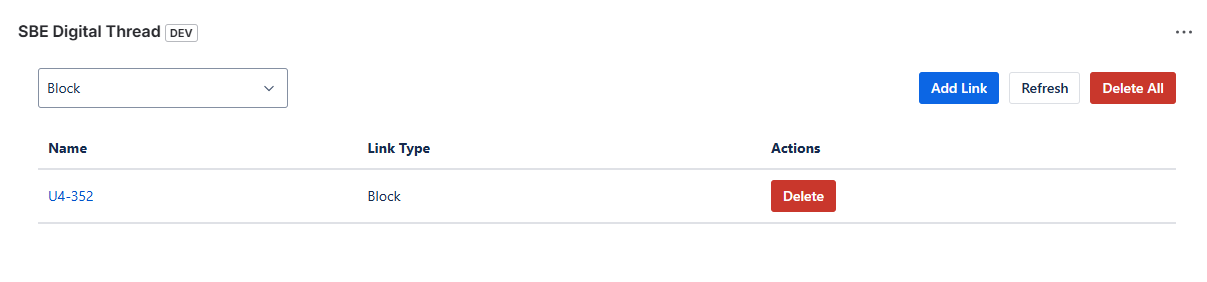
1.7.1 SBE Digital Thread UI
Delete: Remove links that were previously saved in the Jira Server.
Project Settings → Apps → SBE Digital Thread,or you can directly acess it through sidebar as shown in fig [1.7.2 SBE Digital Thread (Delete Links)].
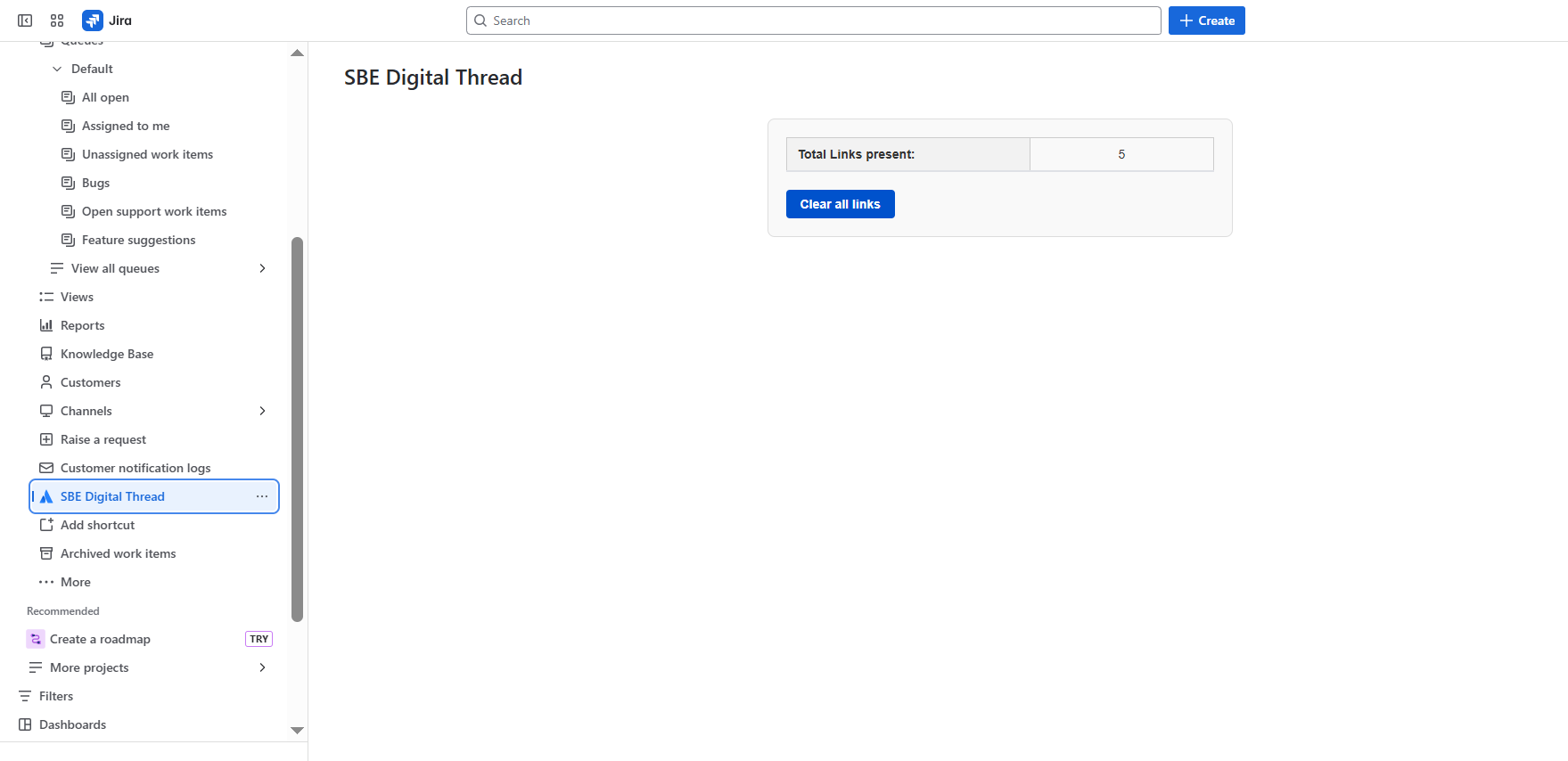
1.7.2 SBE Digital Thread (Delete Links).
1.8 ASOT Link Creation
ASOT links are created when a relation points to an item that resides outside the current Jira channel or originates from a non-Jira authoritative system. Instead of generating a native Jira issue link, the adapter classifies such relations using the target item’s ownership metadata and records them as ASOT links to accurately represent cross-system dependencies. During processing, the adapter prevents duplicate ASOT links by validating against existing stored entries, which is essential because external systems often do not provide consistent correlation identifiers. Newly detected ASOT links are collected throughout the refresh cycle and persisted in a single batch to ensure consistency, reliability, and proper synchronization of external references across integrated systems.
Jira to Jira ASOT Link creation
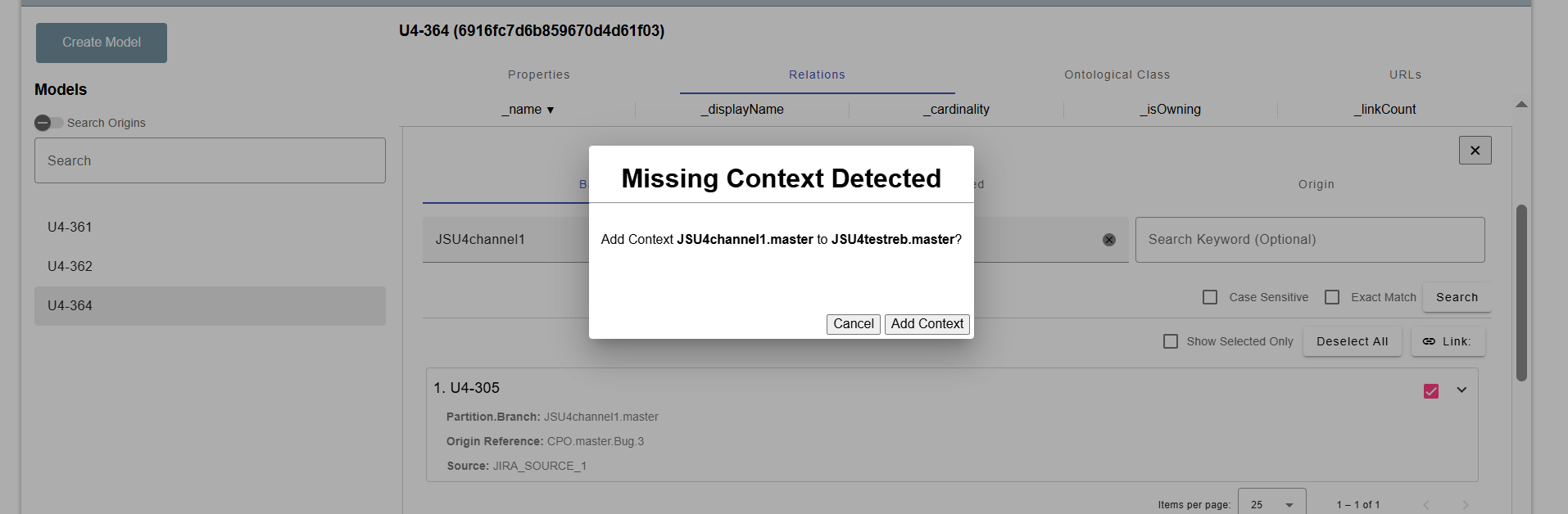
This plugin supports Jira to Jira ASOT linking .ASOT Link created through one channel of Jira to another channel .
ASOT link created through one channel of Jira to another channel.
For creating ASOT link make sure the contex is available for the target item.

Jira to non-jira(cameo,creo,windchill etc) ASOT Link creation
Our plugin supports Jira to non Jira(cameo,creo,windchill,aras,etc) ASOT linking .ASOT Link created through one channel of Jira(source channel) to another non Jira channel(cameo,creo,windchill,aras,etc) which is target channel .
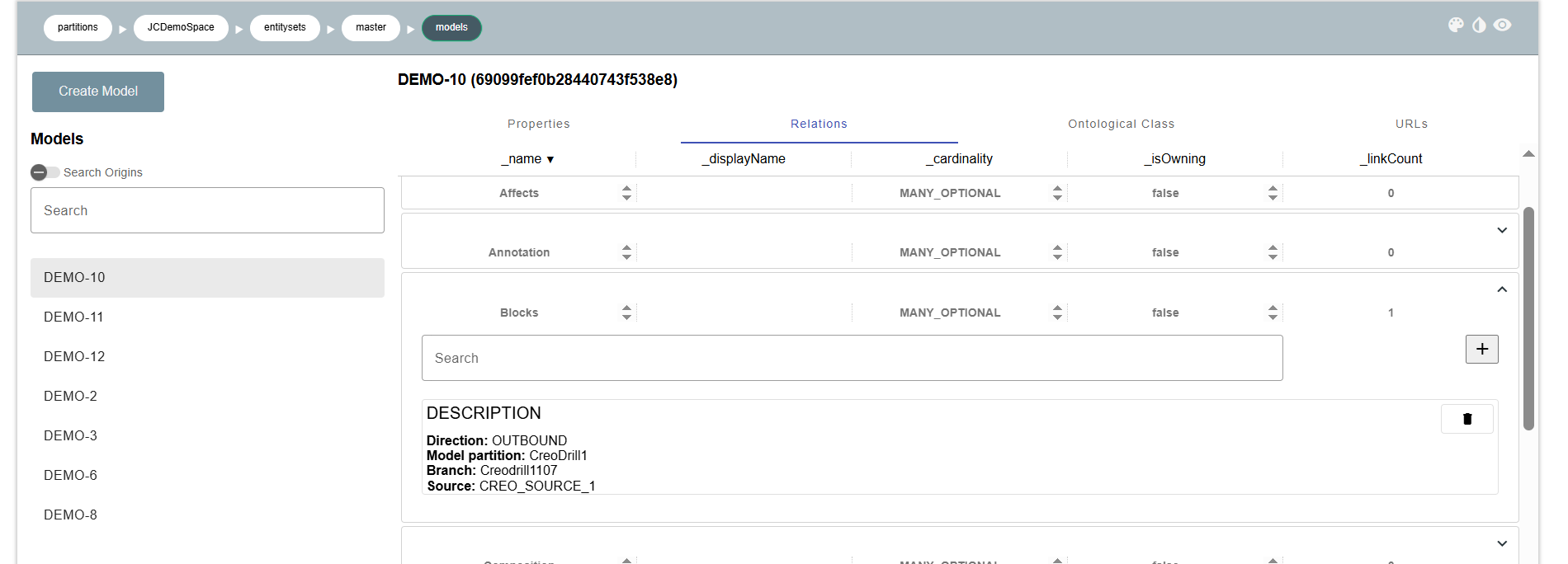
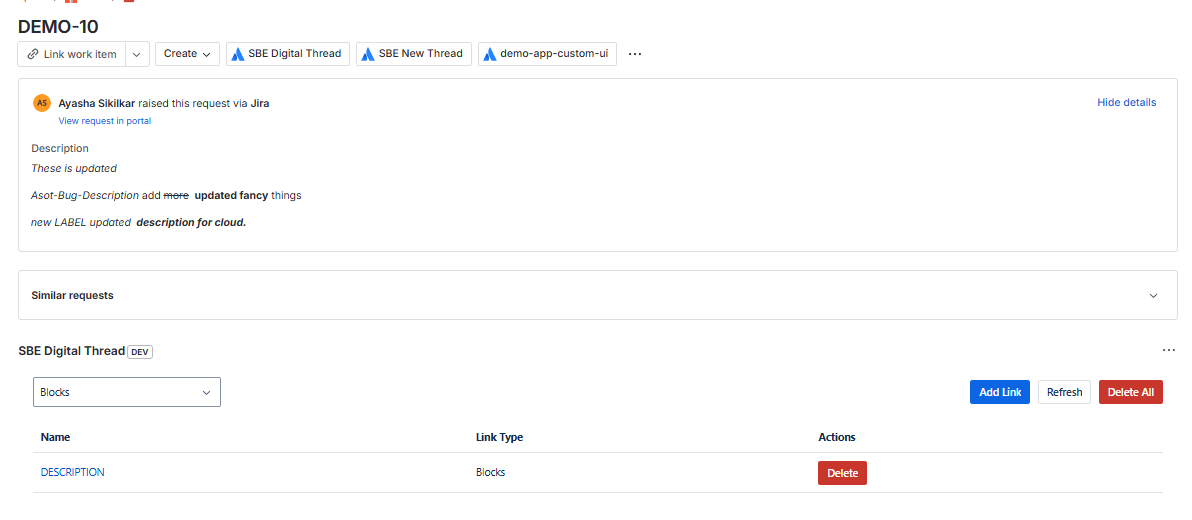
ASOT link created through one channel of Jira to another channel.
For creating the ASOT link make sure the context is available for the target item.If context is missing, then you are not able to see the link in the plugin if link is created through SBE, vice versa for the server.
This feature is available starting from version 8.x.
1.9 Troubleshooting for End Users
Links Not Visible in Kibana (on the Issue)
This may occur if the
apiUrlandapiTokenare not configured properly.Please ensure both are set.
Please verify link mappings.
Links Visible in Kibana, But Not in Authoring (Post-Process)
In such cases, the reflected links may not have been transformed correctly.
This typically indicates an issue during the link transformation phase.
Tracking Pipeline Does Not Finish
One common reason is the presence of stale links.
What are stale links?
Stale links are those created on a different SBE instance or stack.
If the stack is reset or re-deployed, such links become invalid.
It's important to clear old links from the plugin when resetting stacks.
Solution:
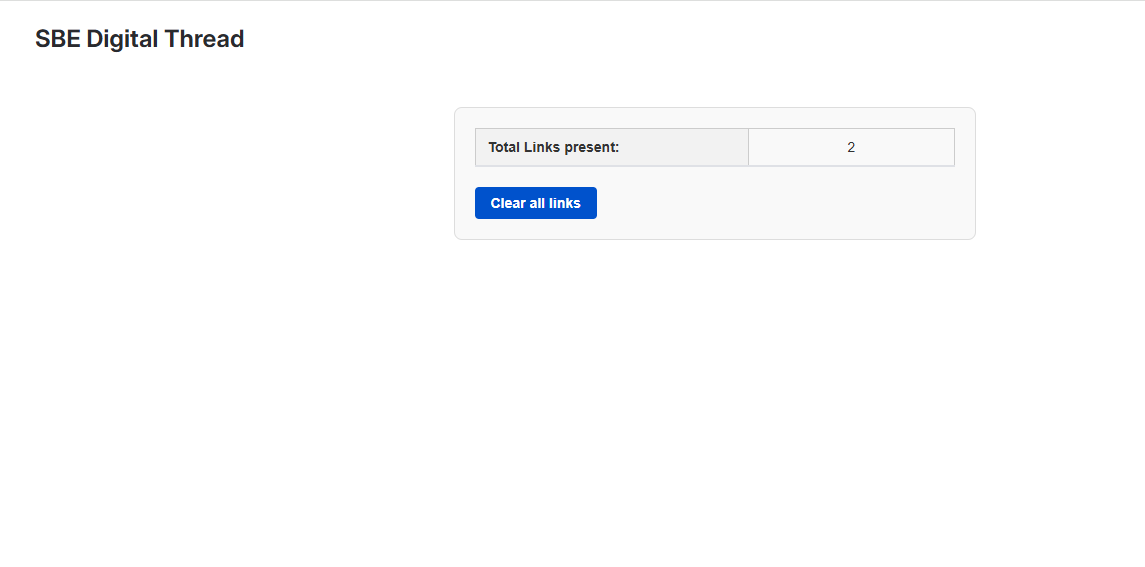
You can remove stale links from the Project Settings.
Click on Clear all links, it will remove all stale links.
2. Document Overview
2.1 Document Overview
This states that the documentation provided is for the Jira plugin only. For general operation and configuration of the adapter, you should refer to the Jira Adapter documentation
2.2 Document Orientation
This document is designed to inform users with various roles:
End Users should begin with Section 1 to understand how to access and operate the adapter, and Section 5 for issues pertaining to the setup, configuration, and use of the digital tool itself.
Digital Thread Specialists should focus on Section 1, and also consult Sections 3, 4, and 5 for deployment and semantic mapping. Section 11 contains details related to mapping items from this tool into a semantic ontology.
Administrators should refer to Section 6 and beyond for setup, security, support, and version management.
3. Adapter Use Cases
3.1 Adapter Overview
The purpose of this adapter is to allow the data contained within instances of Jira to connect with the SBE Digital Thread platform. The provided sources include an overview of the Jira plugin. It adds a Digital Thread panel on a Jira Issue and enables linking to SBE Models. This adapter was built using the SBE Java Pro-SDK product.
3.2 Typical Use Cases
Why this adapter exists
What problem it solves in the system development lifecycle
reqs ↔ architecture with diff/merge in between
Example: “Sync requirements from Tool A to Tool B”
Step-by-step walkthroughs or diagrams
4. Supported Versions
4.1 Supported Adapter Products
This document covers all the version of adapter that support SBE 7.x (Woburn)
4.2 External Tool Versions Supported
Jira Cloud
4.3 Differences Across Tool Versions
NA
4.4 Supported Plug-Ins and Add-Ons
NA
5. Digital Tool Best Practices
5.1 Tool Configuration Considerations
Generate the Jira Cloud Token, required for authentication
Set API URL and API Token for publishing links.
Configure additional settings such as link types and DT table fields.
5.2 Usage Tips & Gotchas
Configuring Link Types
Link types can be configured using a comma-separated list in the appropriate configuration field.
Digital thread table columns can be configured using a comma-separated list which will be shown on the Digital Thread Plugin Panel.
The configured types will appear as a dropdown menu on the Jira issue UI for selection.
How Links Are Created and Stored
User Action
The user creates a link using the SBE UI.
Automatic Subscription
SBE automatically creates a subscription for the selected channel.
Payload Transmission
The payload for the selected models is sent back to the Jira plugin.
Link Storage
The Jira plugin stores:
The issue key
The selected relation type
The model metadata
And any additional data returned from the SBE backend.
Publishing
When the user triggers Publish, the stored links are published.
5.3 Tool Limitations and Workarounds
Known tool-side issues
SBE-recommended solutions
6. Installation
6.1 Installation Instructions
Create token for authentication (Refer to Section 8.1)
Set up plugin configuration from admin page (Refer to Section 6.2)
Generate token for internal and external APIs (Refer to Section 11.1)
6.2 Configuration
To use the Digital Thread plugin on Jira Cloud, it must be configured to connect to the appropriate SBE server. Follow these steps:
Navigate to Settings →Billing →Site settings →Connected Apps →SBE Digital Thread
In the three dots menu, Click on Configure.
Enter the SBE root URL (e.g.,
https://sbe.acme.com).Configure Link Types using comma-separated values. These types will appear as a dropdown when linking issues to models.
To enable link publishing from Jira, configure the DT Internal API and its related token:
These values must be added to the SBE
Datasourcefields:apiUrlandapiToken
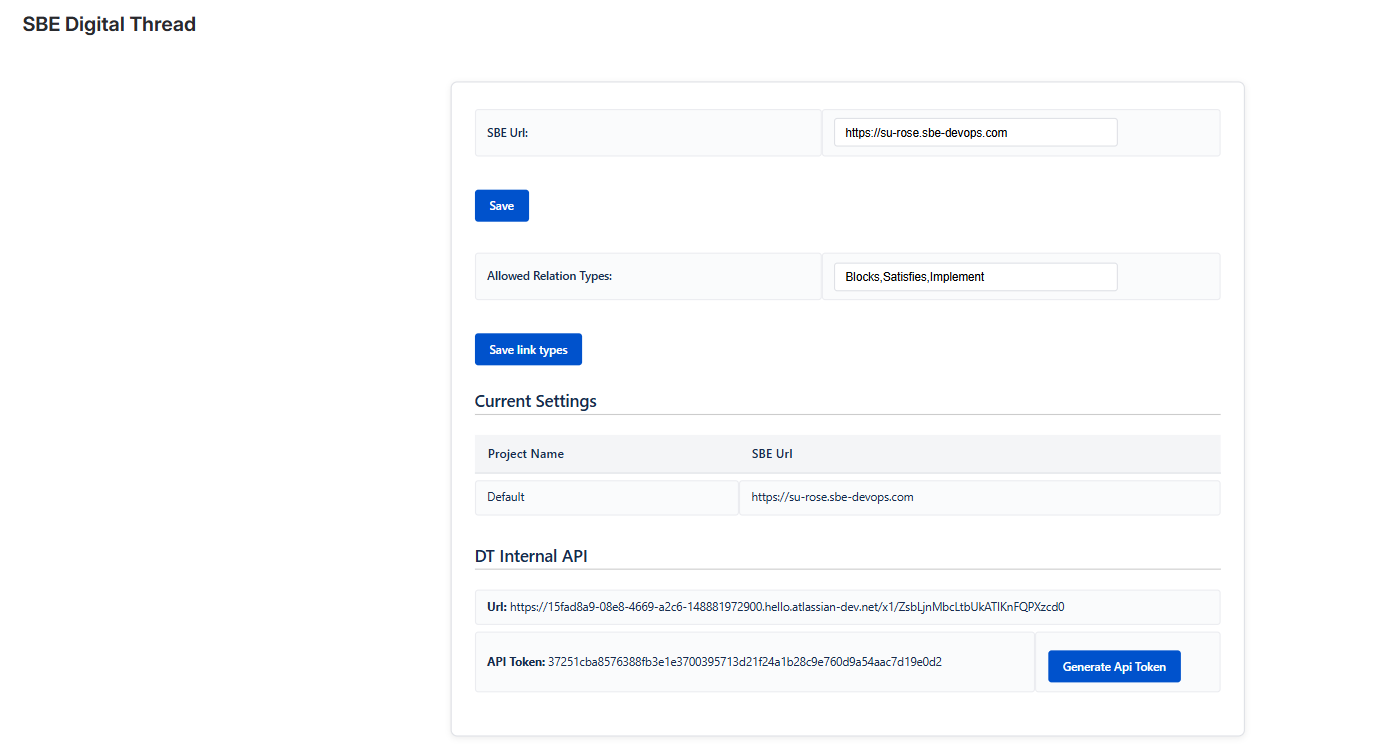
Admin Page
6.3 Data Source Type Definition
Data source definition contains the following properties
Property | Description |
|---|---|
| Hostname of the Jira instance. |
| Port at which the Jira instance runs (e.g., |
| Protocol used – either |
| Authentication type. Valid values are |
| Hostname of the proxy server (if applicable). |
| Port number of the proxy server. |
| Plugin API token (required for Jira Cloud authentication). |
| Plugin API URL (applicable to Jira Cloud). |
| Used to customize the display name. Valid values: |
7. Channels and Mappings
7.1 Channel Definition
Property | Required | Description |
|---|
| Yes | The key of the project. Example: Project Name –
|
| No | Only issues linked to the specified release will be published. |
| No | Only issues linked to the specified component will be published. This value is case-sensitive. |
7.2 Approaches to Mapping
All shapes published from Jira are considered issues. The METACLASS used for these is always
Issue.The exact Jira issue type (like Story, Epic, Task, Bug) is captured using a
STEREOTYPEshape on top of the MetaClass.For example, to map an Epic:
Use
Issueas the METACLASS .Use
Epicas the STEREOTYPE in the inherited ontology class.
Map custom links to respective relations on the METACLASS.
The issue type is determined by this combination:
shapeId = Issue,type = METACLASSshapeId = Story/Epic/etc.,type = STEREOTYPE
Mapper Considerations
Mappers must ensure that the required properties (
summary,issueType,key, etc.) are correctly mapped for data to flow between systems.When customizing the mapping or modifying ontology classes, maintain the integrity of
MetaClassandStereotypestructures to avoid type mismatches.Incorrect or missing stereotype mappings can cause subscription and sync failures.
8. Security and Access
8.1 Authentication Methods
Jira Cloud Authentication
Set Up cloud token
To publish from Jira Cloud, the user needs to use an API token as the password and their email ID as the username.
To generate an API token:
Click on the Manage Account button from the top right user profile. This will take you to your profile page.
Go to the Security page, and under the API token section, click on Create and manage API tokens.
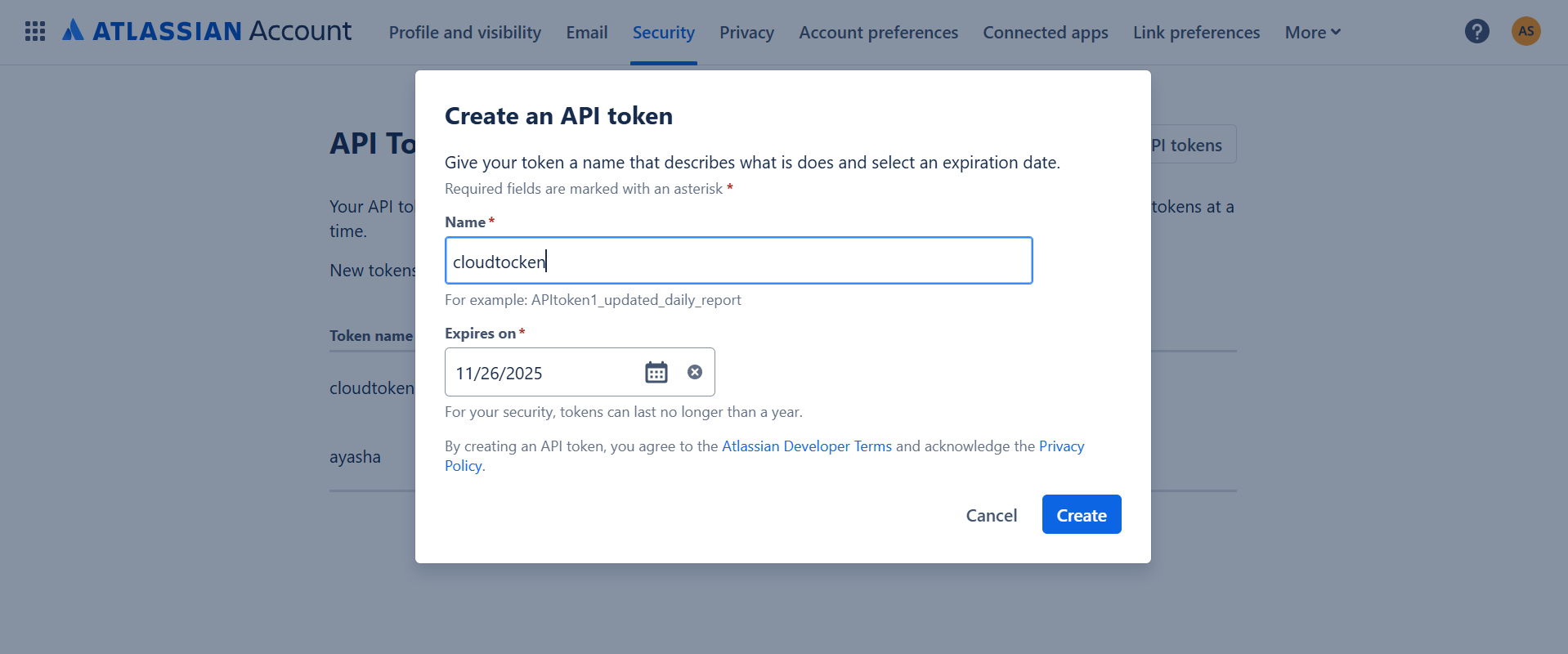
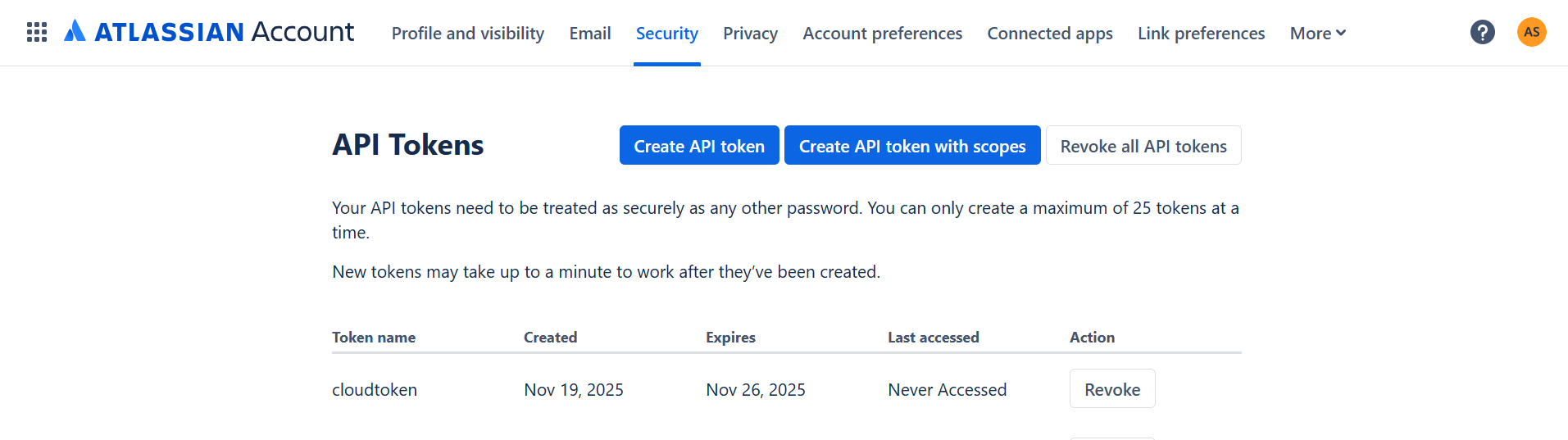
Click on the Create API token button to generate a new token. Make sure to save the token in a safe place, as it cannot be retrieved again once generated.
8.2 Authorization and Roles
REST API access is enabled by default for all users on Jira.
This means any authenticated user can perform standard API operations like GET and POST based on their Jira permissions.DELETE API calls are permission-restricted and depend on the user's role and project-level permissions.
For example, an admin user typically has the required permissions to perform delete operations, while regular users may not.
Always ensure the user has appropriate Jira permissions before invoking operations that modify or delete data.
8.3 Secure Communication
TLS configuration
Firewall or VPN guidelines
8.4 Identity Integration
LDAP, SSO, or identity federation
9. Troubleshooting
9.1 Known Issues
Compatibility limitations
Common operational issues
Maximum item-size limitations
Performance Issues
9.2 Logs and Diagnostics
Where logs are located
Enabling debug output
9.3 Common Misconfigurations
Setup pitfalls
Misuse scenarios
9.4 Escalation and Support
How and when to contact SBE support
Required logs or artifacts
10. Release Notes
10.1 Version History
Release Notes
7.0
Save Issue Id on links
3.14.0
Updated the
Overviewsection in the documentation
3.13.0
Bug fixes on link retrieval
3.12.0
Save Issue Id on links
3.11.0
SBE icon in issue panel
Improve Web API performance
3.10.0
Show more properties in Digital Thread Panel
Woburn Upgrade Support
3.9.0
Resolved embedded channels display issue
3.8.0
Fix issue with link deletion
3.5.0
Get Issue ID for web API
Auto move storage
3.4.0
Add new Web Trigger to get links saved in Jira
Fix issue on Project admin screen
2.1.0
Improve linking with Auto Subscriptions
Support Migration of links
Plugin version 3.2.0
2.0.0
Store links in Jira
Add Web trigger to get the saved links
Admin option to create link types
1.2.0
Fix login issue
Use centralized config for all projects
1.1.0
Fix styling on Plugin
Updates to Admin page to show current settings
1.0.0
First version of the plugin
Support SBE Model linking
11. Technical Reference
11.1 Adapter API Endpoints
Internal API

INTERNAL ONLY:
This API is used exclusively by the Jira Adapter to retrieve stored DT links from Jira Cloud for further publishing to SBE.
It is not intended for public or external consumption.
Purpose
The API fetches only existing links that are stored within Jira Cloud.
The Jira Adapter consumes this response to publish those links to the SBE system.
Authentication Header Configuration
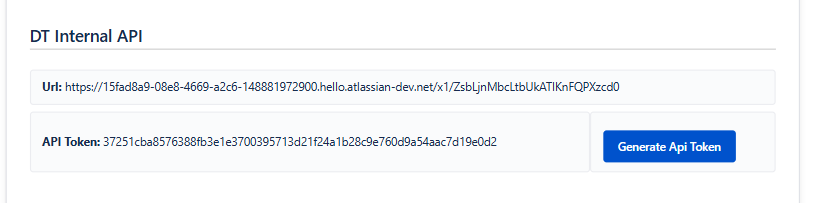
dt-api-key: <your-generated-token> To generate this token:
Go to Settings → Manage Apps →Take me there →SBE Digital Thread →Configure
Click "Generate Api Token" under the DT Internal API Access section.
Request Body
{
  "projectId": "PROJ-1"
}
projectId must be a valid Jira project key (e.g., "U4").
Sample API Response
Returns an array of Digital Thread link objects associated with the given project:
[
        "id": "97b9c870-4b79-48b3-ba52-2824b151c529",
        "targetName": "U4-352",
        "asotUri": "",
        "linkType": "Block",
        "targetFqn": "68762779309cc7467958e809.68762785309cc7467958e80b.68be811e0b950f2bba06f7da",
        "projectKey": "DEMO",
        "issueId": "10106",
        "issueKey": "DEMO-11",
        "channel": "79",
        "dataSourceType": "JIRA",
        "dataSource": "JIRA_SOURCE_1",
        "externalLocator": "{\"__sbe_type\":\"item\",\"__sbe_item_type\":\"Issue\",\"id\":\"35959\"}"
]
Use the appropriate Jira Cloud Token depending on your environment.
11.2 Identity
Description of external locator or mechanism of identity
11.3 Configuration File Format Reference
Set up API Token and API URL
Generate API token for
DT Internal API.After setting up the plugin, you can create a data source using the
DT Internal APIforapiTokenandurlproperties and create links directly from the issue.
11.4 Schema Support
Link Schema
{
        "id": "97b9c870-4b79-48b3-ba52-2824b151c529",
        "targetName": "U4-352",
        "asotUri": "",
        "linkType": "Block",
        "targetFqn": "68762779309cc7467958e809.68762785309cc7467958e80b.68be811e0b950f2bba06f7da",
        "projectKey": "DEMO",
        "issueId": "10106",
        "issueKey": "DEMO-11",
        "channel": "79",
        "dataSourceType": "JIRA",
        "dataSource": "JIRA_SOURCE_1",
        "externalLocator": "{\"__sbe_type\":\"item\",\"__sbe_item_type\":\"Issue\",\"id\":\"35959\"}"
}
11.5 Glossary of Terms
Common technical terms across tools/adapters
11.6 Compliance and Certification
ITAR, DoD, or cybersecurity compliance info (if applicable)
Adapter Maturity Model ratings
11.7 Migrate from SBE 7.x to SBE 8.x
This section will cover the guide to upgrade from your SBE 7.x to SBE 8.x